Loading...
Pakistan · FBR compliance
FBR digital invoicing, built into your ERPNext
Report sales invoices to FBR from the system you already invoice in. Each invoice gets its FBR invoice number and QR code, and your sales tax reports come from the same records.
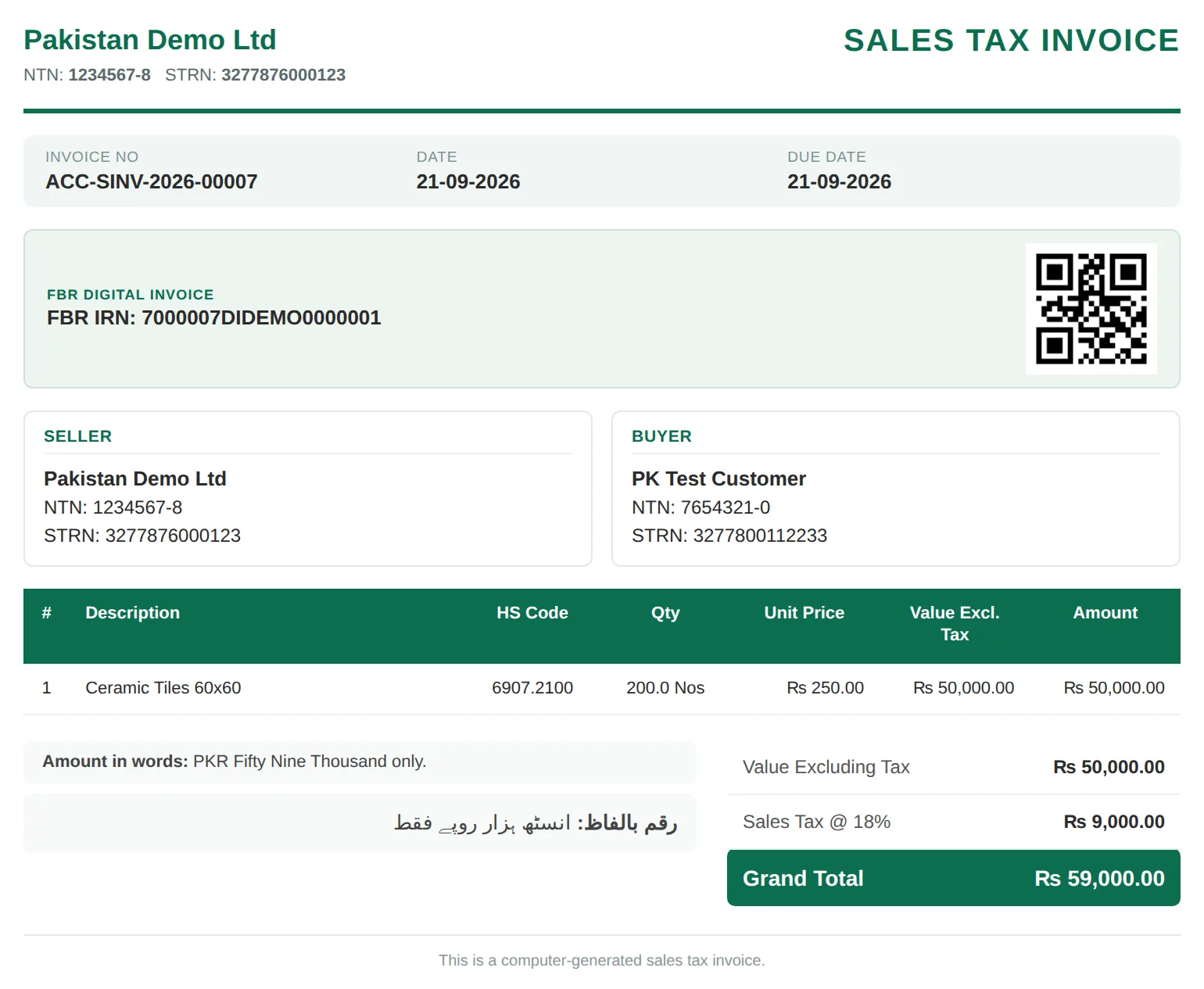
Illustrative screens, sample data.
The requirement
What FBR asks of a registered business
A short summary of FBR's published guidance, not tax advice. The Sales Tax Act and Rules prevail, and integration dates are notified by FBR and have changed more than once. Read FBR's e-invoicing FAQ
01
Who it applies to
FBR's FAQ states that electronic invoicing is mandatory for corporate and non-corporate registered persons, citing S.R.O. 709 of 22 April 2025.
02
Through a licensed integrator
Your ERP or invoicing system has to be integrated with FBR through a licensed integrator, as set out in Chapter XIV of the Sales Tax Rules, 2006.
03
PRAL is the free route
PRAL, FBR's technology company, acts as a licensed integrator and provides integration services free of cost. FBR itself charges no fee.
04
Late integration is penalised
Missing the integration date notified for your category falls under the penalties in Section 33 of the Sales Tax Act, 1990.
Day to day
From sales invoice to FBR invoice number
Your team keeps invoicing in ERPNext. Reporting to FBR becomes one more step on a document they already use, not a second system to re-key into.
- 01
Your tax identity is set once
NTN and STRN on your company, NTN, STRN or CNIC on customers, HS codes on items and a province on addresses. ERPNext gets dedicated fields for each.
- 02
You submit a sales invoice as usual
Nothing changes for the person raising the invoice. It is created and submitted in ERPNext the way it is today.
- 03
The invoice is reported to FBR
One action on the sales invoice sends it to FBR's digital invoicing system in the format FBR expects, including seller and buyer details, HS codes, quantities and tax.
- 04
FBR's number comes back
The FBR invoice number is saved against the ERPNext invoice and printed on it together with the QR code.
- 05
Every invoice has a log
Each reported invoice keeps a record of its status and FBR's response, so finance can see what was accepted, what was rejected and why.
What it does
Pakistan tax compliance, inside ERPNext
Digital invoicing is the part with a deadline. The same setup also covers the tax accounts, withholding, print formats and return reports a Pakistani business needs.
FBR digital invoicing
Sales invoices are reported to FBR from inside ERPNext. The FBR invoice number and QR code are stored on the invoice and appear on the printed copy.
Returns and credit notes
A return is reported against the original invoice it reverses, and prints on its own credit note format.
Sandbox and production
Switch between FBR's sandbox and production environments, and select the FBR test scenario you are running while you clear sandbox testing.
Point-of-sale sales
POS sales are reported in the background so the till is never held up. If FBR cannot be reached, the sale is retried automatically and anything that still fails is listed for a supervisor.
Pakistan tax setup
Tax accounts and templates for federal sales tax on goods, further tax, provincial sales tax on services (SRB, PRA, KPRA, BRA, ICT), zero-rated and exempt supplies. Rates stay editable.
Withholding tax
Filer and non-filer withholding categories for goods, services, contracts, commission and rent. Tax is deducted on purchase invoices, with a printable withholding tax certificate.
Sales tax return reports
Annexure C for sales and Annexure A for purchases, plus a withholding tax statement under Section 165, with totals that reconcile to the posted invoices.
Print formats for Pakistan
Sales tax invoice, credit note, sales order, delivery challan, purchase order, quotation and payment voucher, showing NTN, STRN, HS codes and the amount in words in English and Urdu.
Built into ERPNext
It works through standard ERPNext documents, buttons, print formats and reports on ERPNext 15 and 16. FBR credentials are stored encrypted.
Getting there
Four steps to going live on FBR
You know what you have at the end of each step before the next one starts.
01
Readiness check
We review your ERPNext version, your item and customer data, and your FBR registration.02
Install and configure
The integration is installed on your ERPNext and your tax identity, accounts and templates are set up.03
Sandbox testing
Your invoices are tested against FBR's sandbox for the scenarios that apply to your business.04
Go live
With your production token in place, real invoices are reported and your team is shown the daily routine.
Before we start
What you will need to have ready
Most delays come from missing master data, not from the integration. The readiness check tells you exactly what is missing.
- FBR registration
- Your NTN and STRN, and access to FBR's IRIS portal to choose an integrator and generate tokens.
- Item data
- An HS code on every item you sell.
- Customer data
- NTN or CNIC for your buyers, and the province on their address.
- Hosting details
- The IP address of the server your ERPNext runs on, for registration with the integrator.
Is your ERPNext ready for FBR?
A free readiness check covers your ERPNext version, your item and customer data, and your FBR registration, and ends with a clear list of what is needed to go live.
FAQ
FBR digital invoicing questions
What finance teams and business owners ask us first.
Do we need a licensed integrator to connect ERPNext to FBR?
Yes. FBR requires POS, ERP and other invoicing systems to be integrated through a licensed integrator. PRAL, FBR's technology company, is one and provides integration free of cost; private licensed integrators may charge. We configure ERPNext to work with the integrator you select.
Our ERPNext was set up by another partner, or by us. Can you add FBR digital invoicing to it?
Yes. It installs on an existing ERPNext 15 or 16 system. We start with a readiness check of your version, customizations and data, so we know it will install cleanly before anything is changed.
What does FBR need on each invoice?
The seller and buyer details including NTN or CNIC and province, and for every item its HS code, quantity, unit, value and sales tax. If items or customers are missing these, the readiness check lists them so they can be completed before go-live.
What happens if FBR's system is unavailable when we invoice?
The sales invoice stays in ERPNext and can be reported again; the log shows the reason it was not accepted. Point-of-sale sales are queued and retried automatically, and any that still fail are listed in a report for a supervisor.
Does it file our sales tax return?
It prepares the figures. The Annexure C and Annexure A reports and the Section 165 withholding statement are produced from your posted invoices for the period. Filing the return with FBR remains with you or your tax adviser.
Are the tax rates fixed in the system?
No. Sales tax and withholding rates are created as standard ERPNext tax templates and categories that you can edit. Rates in Pakistan change with each Finance Act and SRO, so they should be confirmed for your period before filing.
When do we have to be integrated?
FBR notifies integration dates by taxpayer category and has revised them more than once, so check FBR's current notification or ask your tax adviser. We can tell you how long your own integration would take once we have seen your system.
What does it cost?
It depends on your ERPNext version, how complete your item and customer data is, and whether you need point-of-sale reporting. We quote after a free readiness check.